
How to Claim Asylum in Canada 2026 Step-by-Step Guide
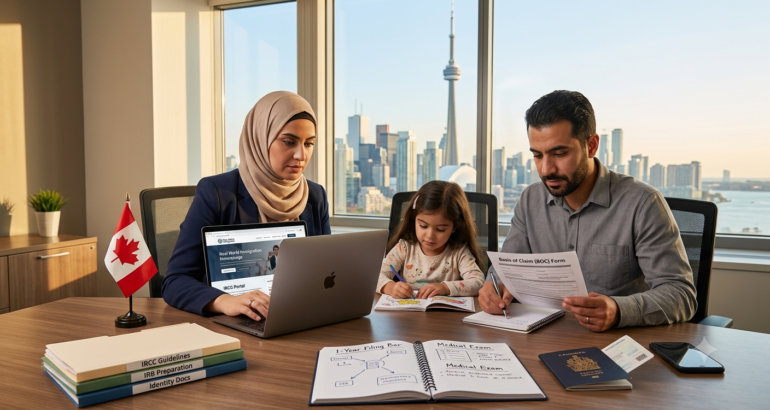
Fleeing persecution, conflict, or serious threats to personal safety in your home country is one of the most challenging experiences anyone can face. If you have arrived in Canada and require international protection, understanding the legal framework for claiming asylum is critical.
Canada operates a well-defined legal framework for protecting individuals who meet the international definition of a Convention Refugee or a Person in Need of Protection. However, recent legal updates in 2026 including stricter eligibility rules under Bill C-12 and updated digital filing timelines mean that navigating the process requires precision, complete honesty, and strict adherence to procedural deadlines.
This guide details the step-by-step inland asylum process in Canada, crucial eligibility rules, document preparation, and how to prepare for your Immigration and Refugee Board (IRB) hearing.
Direct Overview: How Canada’s Asylum Process Works in 2026
To claim asylum from within Canada, you must submit an electronic claim through the Immigration, Refugees and Citizenship Canada (IRCC) Portal. Your claim is first assessed for baseline legal eligibility by an IRCC or Canada Border Services Agency (CBSA) officer. If eligible, your case is referred to an independent administrative tribunal the Refugee Protection Division (RPD) of the Immigration and Refugee Board of Canada (IRB) which makes the final decision on whether to grant refugee status.
+-----------------------------------------------------------------------+
|                       1. INLAND ASYLUM FLOWCHART                      |
+-----------------------------------------------------------------------+
  [Submit Claim on IRCC Portal]
               │ (Upload BOC Form, Identity Documents, Evidence)
               ▼
  [Acknowledge of Claim & Medical Exam]
               │ (Receive Instructions & Complete Biometrics)
               ▼
  [IRCC / CBSA Eligibility Interview]
               │
      ┌────────┴────────┐
      ▼                 ▼
[Eligible Claim]    [Ineligible Claim]
      │                 │
      │                 └─► Directed to CBSA (Removal / PRRA Options)
      ▼
[Referral to IRB (RPD)]
      │ (Receive RPID & Work Permit Eligibility)
      ▼
[IRB Refugee Hearing]
      │
      ├─► [APPROVED]  ──► Granted Protected Person Status ──► Apply for PR
      └─► [REJECTED]  ──► Appeal to RAD or Federal Court Review
2026 Key Asylum Rules Summary
| Step / Requirement | Key Condition | Critical Rule / Deadline |
| Primary Portal | Electronic filing via the official IRCC Portal | Drafts expire 90 days after starting online |
| 1-Year Filing Bar | Claims must be made within 1 year of first entry | Strict ineligibility rule for late inland claims |
| Safe Third Country Rule | Applies at land border points of entry with the U.S. | Barred if claimed >14 days after non-designated border crossing |
| Key Document | Basis of Claim (BOC) Form | Must be submitted with or shortly after the portal claim |
| Interim Coverage | Interim Federal Health Program (IFHP) | Granted once claim is declared eligible |
Understanding Legal Eligibility: Who Can Claim Asylum?
Before initiating an asylum claim, it is essential to determine whether your situation meets Canada’s legal definitions under the Immigration and Refugee Protection Act (IRPA) and whether you are legally eligible to file.
1. Legal Grounds for Protection
To be granted refugee status, you must meet one of two legal criteria:
- Convention Refugee: You have a well-founded fear of persecution in your home country based on your race, religion, nationality, political opinion, or membership in a particular social group (such as sexual orientation, gender identity, or social activism).
- Person in Need of Protection: Returning to your home country would expose you personally to a danger of torture, a risk to your life, or a risk of cruel and unusual treatment or punishment.
2. Critical Ineligibility Bars to Keep in Mind
Not everyone who applies inside Canada can have their claim heard by the IRB. Under official IRCC Inland Asylum Eligibility Standards, your claim will be declared ineligible and will not be referred to the IRB if:
- The 1-Year Filing Limit: You made your refugee claim more than 1 year after your first entry into Canada (applicable to entries after June 24, 2020).
- The 14-Day Land Border Rule: You entered Canada from the United States between official ports of entry and waited more than 14 days to submit your claim.
- Prior Protection elsewhere: You have already been recognized as a Convention Refugee by another country that you can safely return to.
- Previous Claims in Canada: You previously made an asylum claim in Canada that was rejected, abandoned, withdrawn, or found ineligible.
- Security or Criminal Inadmissibility: You are deemed inadmissible to Canada on serious grounds of criminality, organized crime, or human rights violations.
- Safe Third Country Agreement (STCA): You arrived at a Canada-U.S. land border crossing without qualifying for an explicit STCA exception (such as having immediate family members residing in Canada).
If your claim is determined to be ineligible, you will not receive an IRB hearing. Instead, you may be issued a removal order, though you may eventually qualify for a Pre-Removal Risk Assessment (PRRA) or a Humanitarian and Compassionate (H&C) application depending on your timeline.
Step-by-Step Inland Asylum Claim Process in 2026
If you are currently inside Canada and meet the eligibility requirements, follow these structured steps to complete your refugee claim.
Step 1: Gather Identity and Supporting Evidence
Before opening an online account, gather as much documentation as possible to support your identity and your underlying narrative.
- Identity Documents: Passports, national identity cards, birth certificates, marriage certificates, driver’s licenses, or school records for every family member claiming asylum.
- Proof of Entry: Entry stamps, visas, boarding passes, or travel itineraries showing when and how you entered Canada.
- Evidence of Persecution: Police reports, medical records showing injuries from physical assault, threatening letters/messages, news articles detailing incidents targeting you or your group, and affidavits from witnesses.
- Country Condition Reports: Documentation showing human rights conditions in your country from recognized sources like Amnesty International or Human Rights Watch.
Step 2: Complete the Basis of Claim (BOC) Form
The Basis of Claim (BOC) Form is the foundational document of your refugee application. It outlines who you are, why you fled your country, what specific dangers you face if forced to return, and why state protection or internal relocation is impossible.
- Tell the Truth in Detail: Every detail in your BOC form will be cross-examined during your IRB hearing. Inconsistencies between your BOC form, verbal interview statements, and uploaded evidence can lead to a negative credibility finding.
- Detailed Timeline: Present a clear, chronological narrative of events leading to your departure.
- Professional Assistance: It is strongly recommended to work with experienced legal counsel when completing this document. Errors or omissions in your BOC form are difficult to correct later in the process.
Step 3: Create and Submit Your Claim via the IRCC Portal
Inland refugee claims are processed through the official electronic portal. You can review guidelines directly at the Immigration and Refugee Board of Canada Claim Guide.
- Create an Account: Visit the IRCC Portal, obtain an invitation code, and register your account.
- Fill Out the Application: You will complete a detailed online questionnaire covering your background, travel history, family composition, and employment history.
- Upload Documents: Attach clear digital scans of your completed BOC form, passports, identity papers, and supporting evidence files.
- Mind the 90-Day Timer: Once you initiate a claim on the IRCC Portal, you have 90 days to complete and submit it. Unsubmitted applications are automatically deleted after 90 days.
IRCC Portal Checklist:
├── Account setup with verified email address
├── Complete background & travel history questionnaire
├── Uploaded Basis of Claim (BOC) form for each family member
├── Clear scans of original identity documents & passports
└── Signed "Use of a Representative" form (if represented by counsel)
Step 4: The IRCC Eligibility Interview and Biometrics
After your portal application is submitted, IRCC will review the submission. If it is complete, you will receive an Acknowledgment of Claim (AOC) letter alongside instructions to schedule an in-person appointment.
At your in-person appointment:
- An IRCC or CBSA officer will verify your identity and conduct an eligibility interview.
- You will submit your original physical passports and travel documents (the officer will retain these and issue certified copies).
- Your biometrics (fingerprints and digital photographs) will be taken if you are 14 years of age or older.
- The officer will assess whether any ineligibility bars apply to your case.
If the officer determines your claim is eligible, they will officially refer your file to the RPD and issue a Refugee Protection Identity Document (RPID).
Step 5: Medical Examination and Work Permit Application
Once your claim is referred to the IRB:
- Medical Exam: You must undergo an immigration medical examination with an IRCC-approved panel physician within the designated timeframe. The cost of this examination and basic healthcare needs are covered under the Interim Federal Health Program (IFHP).
- Work Permit: Eligible refugee claimants can apply for an open work permit once their medical exam results are registered. This allows you to work legally in Canada while awaiting your IRB hearing.
Preparing for Your IRB Hearing
The hearing before the Refugee Protection Division (RPD) is the defining moment of your asylum application. An independent IRB Board Member will preside over the hearing to evaluate your credibility and decide if you qualify for protection.
What Happens During the Hearing?
- Format: Hearings take place in person or virtually via video conference.
- Participants: The hearing involves you (the claimant), your legal counsel, the IRB Board Member, an official interpreter (if requested), and occasionally a CBSA Minister’s Counsel.
- Testimony: You will be asked detailed questions about your narrative, your BOC form, and the evidence you submitted.
- Decision: The Board Member may deliver an oral decision at the end of the hearing or reserve the decision to be delivered in writing at a later date.
How to Build a Strong Evidentiary Case
To maximize the likelihood of a positive outcome:
- Maintain Consistency: Ensure dates, names, locations, and events mentioned during your testimony align perfectly with your written BOC form.
- Corroborate Your Story: Provide objective documentary evidence whenever possible. Independent documentation (medical records, news articles, police filings) reinforces your personal testimony.
- Demonstrate Lack of State Protection: Show why the government or law enforcement in your home country cannot or will not protect you from persecution.
- Explain Lack of Internal Flight Alternative (IFA): Demonstrate why moving to another region or city within your home country would not guarantee your safety.
What Happens After the IRB Decision?
If Your Claim is Approved
If the IRB accepts your claim, you are officially designated a Protected Person.
- You will receive a Notice of Decision confirming your status.
- You can immediately apply for Canadian Permanent Residence (PR) for yourself and eligible family members.
- You will be eligible for federally funded settlement services and provincial healthcare programs.
If Your Claim is Refused
If the IRB rejects your claim, you still have legal avenues for recourse, though strict deadlines apply:
- Refugee Appeal Division (RAD): Most claimants have the right to appeal an adverse RPD decision to the RAD within 15 working days. The RAD reviews the case to determine if the RPD made errors of law or fact.
- Federal Court Judicial Review: If an appeal to the RAD is not permitted or is unsuccessful, you can apply for leave for a Judicial Review before the Federal Court of Canada.
- Pre-Removal Risk Assessment (PRRA): If all appeals are exhausted and a removal order becomes enforceable, you may eventually be invited to apply for a PRRA before deportation.
Crucial Tips for a Successful Asylum Claim in 2026
- Do Not Miss Deadlines: Late submissions of BOC forms, evidence packages, or appeal filings can result in your claim being declared abandoned.
- Obtain Legal Counsel: Navigation of Canadian refugee law is complex. Working with experienced, licensed immigration practitioners drastically improves file preparation and hearing representation. You can review how specialized legal support assists claimants by visiting Real World Immigration’s Refugee and Asylum Legal Services.
- Keep Contact Information Updated: Always inform IRCC and the IRB immediately if you change your address, phone number, or email address. Missing a hearing notice results in claim abandonment.
- Never Travel Back to Your Home Country: Returning to your country of origin while your claim is pending or even after obtaining Protected Person status can cause Canada to revoke your protection under “re-availment” provisions.
Applying for asylum in Canada requires careful planning, attention to detail, and a thorough understanding of procedural requirements. By completing your forms accurately, gathering persuasive corroborating evidence, and adhering strictly to legal timelines, you can present a strong, structured claim for refugee protection.

Swati Raj

Leave a Comment