
How to Become a Canadian Citizen: Step-by-Step Guide
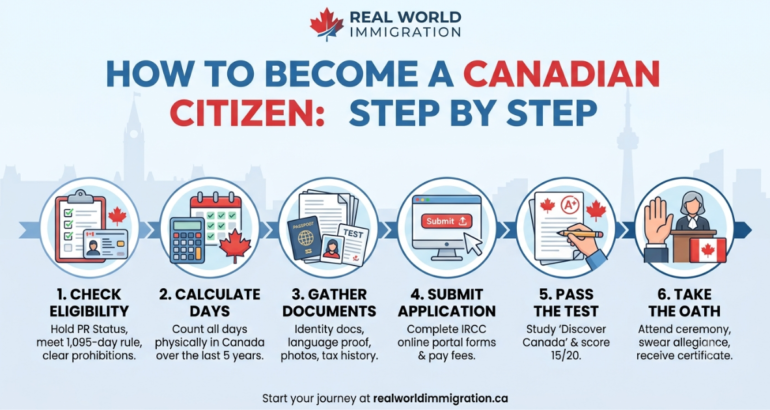
To become a naturalized Canadian citizen, you must first hold Permanent Resident (PR) status in Canada and meet specific legal requirements set by Immigration, Refugees and Citizenship Canada (IRCC). The core requirement is proving physical presence inside Canada for at least 1,095 days (three full years) out of the five years immediately preceding your application date. Additionally, applicants between the ages of 18 and 54 must demonstrate language proficiency in English or French at Canadian Language Benchmark (CLB) level 4 or higher, file Canadian income taxes for at least three tax years, pass a 20-question citizenship test, and take the official Oath of Citizenship.
Holding a Canadian passport is widely regarded as one of the ultimate milestones in global migration. Beyond the ability to travel visa-free to over 180 countries, becoming a Canadian citizen grants you the unconditional right to vote in federal, provincial, and municipal elections, run for public office, hold restricted government security clearances, and live outside Canada indefinitely without ever risking your status.
While the reward is life-changing, the journey from holding a Permanent Resident (PR) card to holding a Citizenship Certificate requires careful legal preparation. IRCC processes hundreds of thousands of citizenship files each year, and even minor errors in travel history logging or document submission can delay an application by several months or lead to a complete return of the file.
Whether you recently became a permanent resident or have lived in Canada for several years, this step-by-step guide breaks down the legal eligibility criteria, physical presence calculations, application steps, and strategic considerations required to complete your transition to a Canadian citizen.
Phase 1: Checking Your Eligibility Criteria
Before filling out an online portal account or gathering identity documents, you must confirm that you satisfy all statutory requirements under Section 5(1) of the Citizenship Act. Eligibility is assessed on the exact date you sign your application.
1. Permanent Resident (PR) Status
You must hold valid Permanent Resident status in Canada at the time of your application. Your PR status must not be under review for non-compliance, you must not be subject to an unfulfilled removal order, and there must be no unresolved immigration conditions tied to your record.
It is worth noting that your PR card does not necessarily need to be valid on the day you sign your citizenship application, as long as your underlying legal PR status remains intact and uncompromised. However, having an unexpired PR card simplifies identity verification during travel and processing. If you need assistance renewing or verifying your status before applying, you can consult the PR status specialists at Real World Immigration.
2. The 1,095-Day Physical Presence Requirement
The physical presence requirement is the single most scrutinized element of any citizenship file. You must have been physically inside the geographic borders of Canada for at least 1,095 days (3 full years) within the 5-year eligibility period immediately preceding the date your application is signed and submitted.
Understanding how IRCC calculates these days is essential:
- Full Days as a Permanent Resident: Every calendar day you spend physically inside Canada after becoming a permanent resident counts as 1 full day toward your 1,095-day requirement.
- Half-Days as a Temporary Resident: Days spent in Canada before acquiring PR status—such as time spent on a valid study permit, work permit, visitor visa, or as a protected person—count as 0.5 days (half a day) per calendar day.
- The Pre-PR Credit Ceiling: You can claim a maximum credit of 365 days for temporary resident time. This means that even if you lived in Canada on a work permit for four years before obtaining PR status, only two of those years (730 calendar days × 0.5 = 365 physical presence days) can be applied toward your total.
- Border Crossings & Travel Counting: Any day where you were physically in Canada for any part of the day counts as a day in Canada. For example, if you leave Canada on Tuesday morning for a business trip and return on Thursday evening, Tuesday and Thursday count as days in Canada, while Wednesday counts as a full day absent.
Expert Recommendation: Do not apply on the exact day you hit 1,095 days. Always build a “buffer” of at least 15 to 30 extra days of physical presence. If IRCC recalculates a travel date differently based on CBSA border records or passport stamps, having extra days prevents your file from being rejected for falling short by a single day.
3. Income Tax Filing Obligations
To ensure new citizens are contributing to the national framework, IRCC requires citizenship applicants to have filed personal income taxes in Canada for at least 3 tax years within the 5-year eligibility window preceding the application. Even if you earned no income during a specific tax year, filing a $0 tax return with the Canada Revenue Agency (CRA) satisfies this legal requirement.
4. Language Proficiency (Ages 18 to 54)
If you are between 18 and 54 years old on the date you sign your application, you must prove that you possess adequate knowledge of either English or French. IRCC defines this standard as Canadian Language Benchmark (CLB) Level 4 or higher in speaking and listening.
CLB Level 4 is a basic conversational standard. It means you can follow simple instructions, express basic needs, use everyday vocabulary, and communicate in routine social or workplace situations. You can prove this through several accepted avenues:
- Results from an approved third-party language test (such as CELPIP-General, IELTS General Training, or TEF/TCF Canada) meeting CLB 4.
- Proof of completion of secondary or post-secondary education taught in English or French (e.g., a Canadian high school diploma, college diploma, or university degree transcript).
- Proof of achieving CLB 4 in government-funded language training programs such as LINC (Language Instruction for Newcomers to Canada).
5. Prohibitions and Criminal Background Clearances
You cannot become a Canadian citizen if you are subject to criminal prohibitions under the Citizenship Act. This includes being currently under investigation, facing criminal charges, serving a sentence (prison, probation, or parole) inside or outside Canada, or being subject to a removal order. Time spent serving a sentence in Canada does not count toward your 1,095 days of physical presence.
Phase 2: The Step-by-Step Application Process
Once you have verified that you meet every underlying eligibility criterion, you can move through the six operational steps of the application workflow.
  [ Calculate Physical Presence ]
                 │
                 ▼
  [ Gather Supporting Documents ]
                 │
                 ▼
  [ Submit Application & Pay Fees ]
                 │
                 ▼
  [ Receive AOR & Background Checks ]
                 │
                 ▼
  [ Pass Citizenship Test & Interview ]
                 │
                 ▼
  [ Attend Ceremony & Take Oath ]
Step 1: Calculate Your Physical Presence
Before filling out the main application forms, you must calculate your exact physical presence. IRCC provides an official online tool specifically designed for this purpose: the IRCC Physical Presence Calculator.
To complete this accurately:
- Log into the calculator and enter the date you plan to sign the application. This establishes your 5-year eligibility window.
- Enter all details regarding your status history (dates you held work permits, study permits, or PR status).
- List every single trip you took outside Canada during the 5-year period—including weekend road trips to the United States, vacations, family visits, or foreign business travel.
- Print or save the completed calculation output. You will attach this document to your final application package.
Step 2: Gather Required Supporting Documentation
Failing to attach clear, legibly scanned supporting documents is the primary reason citizenship files are returned as incomplete. Ensure you gather:
- Proof of Physical Presence Calculation: The printed output from the IRCC calculator signed and dated.
- Biographic Pages of Passports: Color scans of all biographic pages (showing name, photo, passport number, and expiration date) of every passport or travel document you held during your 5-year eligibility window.
- Proof of Language Proficiency: Your official test results, educational diploma/transcripts in English or French, or LINC certificates (if aged 18 to 54).
- Two Identical Citizenship Photos: Photos taking into account IRCC’s strict citizenship photo specifications, including the photographer’s name, address, and date taken stamped or written on the back of one photo (or uploaded digitally according to online portal guidelines).
- Identity Documents: Scans of two valid pieces of personal identification (e.g., your Canadian PR Card, driver’s license, or provincial health card).
- Payment Receipt: Proof that you have paid the mandatory government processing fees.
Step 3: Submit Your Application Package and Pay Fees
The government processing fee for an adult Canadian citizenship application is $630 CAD per applicant ($500 processing fee + $130 Right of Citizenship fee). For minor applicants under age 18, the total fee is $100 CAD.
Most adult applicants can complete their application electronically via the IRCC Online Citizenship Portal. The online portal allows you to complete forms directly, upload document scans, attach your physical presence calculator printout, and pay fees in a single place. Paper applications remain available for specific situations, such as family applications submitted together or individuals requesting specialized accommodations.
Step 4: Receive AOR and Background Screening
Once submitted, your application enters IRCC’s queue. After initial completeness checks, IRCC issues an Acknowledgment of Receipt (AOR) email containing your Unique Client Identifier (UCI) and Application Number.
After AOR is issued:
- IRCC initiates background and security screenings in coordination with the Royal Canadian Mounted Police (RCMP) and the Canada Border Services Agency (CBSA).
- Some applicants may receive a request to provide biometric fingerprints at a designated local service center or collection point to complete criminality checks.
- You can track the progress of your application online using the IRCC Citizenship Application Tracker tool.
Step 5: Pass the Citizenship Test and Interview
If you are between the ages of 18 and 54, IRCC will invite you to take the official Canadian Citizenship Test.
- Test Format: The test consists of 20 multiple-choice or true/false questions administered online or in person.
- Time Limit & Passing Score: You have 45 minutes to complete the test. To pass, you must score at least 15 out of 20 (75%).
- Study Material: Every single question on the test is derived directly from the official study guide, Discover Canada: The Rights and Responsibilities of Citizenship. The study guide covers Canadian history, geography, government structure, legal systems, monarchy, national symbols, and economy.
Shortly before or after your test, you may also be scheduled for a short 10-to-15-minute video or in-person interview with a citizenship official. During this interview, the officer verifies your original identity documents, confirms your physical presence details, and verifies that you possess basic spoken language skills.
Step 6: Attend the Ceremony and Take the Oath
Once your test, background clearances, language verification, and physical presence audits are successfully approved, you will receive an official Invitation to a Citizenship Ceremony.
The ceremony takes place either in person at an IRCC office or virtually via a secure video platform. During the ceremony, you will:
- Take the Oath of Citizenship in English or French before a Citizenship Judge or official, swearing allegiance to the Canadian Crown and promising to observe the laws of Canada.
- Sing the national anthem, O Canada.
- Sign your Oath document and receive your official Certificate of Canadian Citizenship.
Upon receiving your citizenship certificate, your journey as a Permanent Resident officially concludes, and you become a full Canadian citizen. You can immediately apply for your first Canadian passport!
4 Frequent Mistakes That Delay Citizenship Applications
Even well-prepared applicants can run into unnecessary processing delays. Avoiding these four common pitfalls will help keep your application moving smoothly.
1. Estimating Travel Dates Instead of Verifying
When logging foreign travel in the physical presence calculator, guessing or estimating departure and return dates based on memory leads to discrepancies with CBSA electronic entry records. Always cross-reference your travel history with passport stamps, flight confirmation emails, credit card statements, or official CBSA border passage history reports requested under privacy legislation.
2. Signing the Application Before Hitting Requirements
The eligibility window closes on the exact calendar day you sign your application form. If you complete your forms online but wait three days to press “submit” without updating your signature date, your physical presence calculation will be inaccurate. Always ensure your calculation printout and signature dates match perfectly.
3. Submitting Expired or Unrecognized Language Proof
IRCC strictly enforces its list of acceptable language documents. Submitting unapproved private language course certificates or unaccredited foreign diplomas causes immediate document rejection. Always ensure your proof matches official IRCC guidance.
4. Failing to Report Ongoing Legal or Tax Issues
Unfiled tax returns for required years or unresolved traffic tickets that led to criminal summary charges must be cleared before applying. Omitting information regarding arrests, charges, or tax adjustments can trigger misrepresentation investigations under the Citizenship Act.
Professional Strategy and Legal Guidance
While applying for Canadian citizenship is designed to be accessible, complex situations—such as extensive foreign business travel, previous temporary resident status calculations, or past immigration compliance reviews—benefit from professional oversight.
Navigating the transition to Canadian citizenship requires accuracy, attention to detail, and a clear understanding of IRCC policy. At Real World Immigration, our team evaluates your travel logs, verifies document eligibility, and prepares complete citizenship applications designed for smooth processing.
If you are ready to take the final step toward becoming a Canadian citizen, contact our experienced team at Real World Immigration to schedule an eligibility evaluation today.

Swati Raj


Leave a Comment