How to Apply for a US Visa from Canada (2026 Guide)
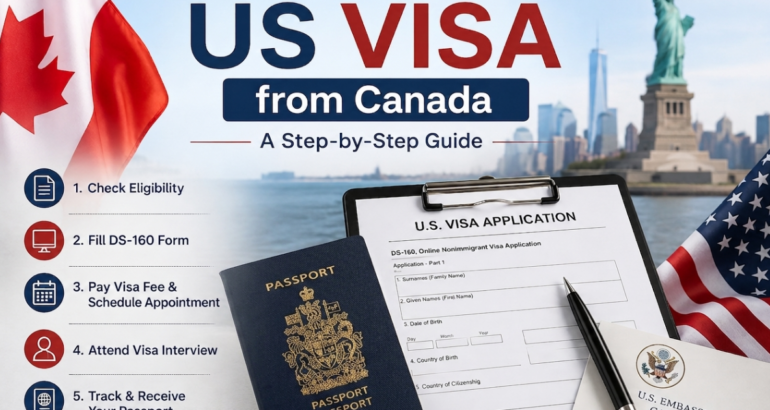
Living in Canada offers incredible lifestyle and professional opportunities, but if you hold a foreign passport, crossing the southern border into the United States requires proper legal authorization. While Canadian citizens enjoy visa-exempt entry into the U.S. for short trips, millions of non-citizens residing in Canada including Permanent Residents (PRs), foreign workers on Post-Graduation Work Permits (PGWPs), and international students must secure a U.S. Nonimmigrant Visa (B1/B2) before traveling.
Navigating the U.S. visa process from inside Canada involves specific administrative workflows. Between filling out the online DS-160 form, navigating the Official U.S. Visa Appointment Service portal (AIS), tracking appointment slot availability across major consulates, and proving strong ties under Section 214(b) of the U.S. Immigration and Nationality Act (INA), a single mistake can lead to months of delays or a refusal.
This comprehensive guide details the step-by-step process of applying for a U.S. B1/B2 visitor visa from Canada in 2026, required financial thresholds, consulate locations, and strategies for a successful consular interview.
Direct Overview: Non-Citizens Residing in Canada
If you reside in Canada as a temporary or permanent resident and hold a passport from a country that is not part of the U.S. Visa Waiver Program (VWP / ESTA), you must complete an in-person visa interview at a U.S. Embassy or Consulate General inside Canada.
2026 Key Application Rules Summary
| Requirement / Component | Details & Specifications | Important Guidance |
| Primary Form | Online Nonimmigrant Visa Application (DS-160) | Must be submitted prior to scheduling an appointment |
| Standard Application Fee | $185 USD (Non-refundable Machine Readable Visa / MRV Fee) | Paid through the official AIS portal |
| Pilot Expedite Option | $750 USD Optional Fee (Select posts, subject to availability) | Pilot program permitting interview dates within 10 business days |
| Key Consular Posts | Toronto, Vancouver, Montreal, Calgary, Ottawa, Halifax, Quebec City | You may apply at any post accepting non-resident/third-country files |
| Core Legal Bar | INA Section 214(b) Presumption of Immigrant Intent | Must prove strong, ongoing ties to Canada or home country |
Step 1: Complete the Online DS-160 Form
The DS-160 (Online Nonimmigrant Visa Application) is the core document of your application. The U.S. Department of State uses the information provided in this form to conduct security background checks and evaluate your preliminary eligibility.
Crucial Steps for Completing Form DS-160:
- Access the Portal: Visit the official Consular Electronic Application Center (CEAC) Portal and select the location where you intend to apply (e.g., Canada, Toronto or Canada, Vancouver).
- Note Your Application ID: Write down the 10-digit alphanumeric Application ID displayed on the top right corner of the screen immediately. This ID, along with your security question answer, allows you to retrieve your draft if your session times out.
- Upload a Compliant Digital Photo: You must upload a clear color photo taken within the last 6 months that meets strict U.S. visa photo specifications:
- Exactly $2 \times 2$ inches ($51 \times 51$ mm) in size.
- Plain white or off-white background.
- No eyeglasses allowed unless worn for documented medical reasons.
- Neutral facial expression with both eyes open.
- Be Accurate with Personal Details: Fill out all background, employment, education, and travel sections truthfully. Ensure that names, dates of birth, and passport details match your original travel documents.
- Print the Confirmation Page: Once submitted, download and print the DS-160 Confirmation Page featuring the barcode. You must bring a physical copy of this page to your interview appointment.
Step 2: Pay the MRV Fee and Register on the AIS Portal
Once your DS-160 form is submitted, you must create a profile on the official U.S. Department of State appointment scheduling system for Canada.
- Register on the Official Site: Go to the Official U.S. Visa Information and Appointment Services Portal for Canada.
- Link Your DS-160: Enter your personal information, current status in Canada (PR, work permit holder, student), delivery address for your passport, and your 10-digit DS-160 confirmation number.
- Pay the Non-Refundable MRV Fee: Pay the $185 USD visa application fee using an accepted payment method (credit card or debit card).
Important Note on Visa Fees: Machine Readable Visa (MRV) fees are strictly non-refundable and non-transferable. Once paid, your fee receipt is valid for 365 days, during which you must schedule your appointment.
AIS Profile Registration Checklist:
├── Valid Email Address & Password setup
├── Selected Passport Courier Pick-up Location in Canada
├── Linked DS-160 Barcode Number entered without spaces
└── Completed $185 USD Payment via Credit/Debit Card
Step 3: Schedule Your Interview Appointment
After your payment is processed, the portal unlocks the calendar showing available interview dates across all U.S. consular posts in Canada.
U.S. Embassy and Consulates in Canada
You can generally schedule an appointment at any of the following official locations processing nonimmigrant visas:
- U.S. Embassy Ottawa: 490 Sussex Drive, Ottawa, ON K1N 1G8
- U.S. Consulate General Toronto: 360 University Avenue (Visa Entrance: 225 Simcoe Street), Toronto, ON M5G 1S4
- U.S. Consulate General Vancouver: 1075 West Pender Street, Vancouver, BC V6E 2M6
- U.S. Consulate General Montreal: 1134 rue Sainte-Catherine O, Montréal, QC H3B 1H4
- U.S. Consulate General Calgary: 615 Macleod Trail SE, Calgary, AB T2G 4T8
- U.S. Consulate General Halifax: 1969 Upper Water Street, Purdy’s Wharf Tower II, Halifax, NS B3J 3R7
- U.S. Consulate General Quebec City: 2, rue de la Terrasse-Dufferin, Québec, QC G1R 4T9
(Note: The U.S. Consulate in Winnipeg does not process nonimmigrant visa applications. Residents of Manitoba are typically routed to Calgary or Toronto).
Handling Long Wait Times and Rescheduling Strategies
Wait times for B1/B2 tourist visa appointments at major consulates like Toronto and Vancouver can extend several months out due to high volume. To optimize your timeline:
- Book the First Available Date: Always book the earliest date shown on the calendar, even if it is months away. Once a baseline appointment is locked in, you can log in periodically to check for earlier cancellations or newly opened interview slots.
- Emergency Expedited Appointments: If you have an urgent, unforeseen travel requirement (such as emergency medical treatment, a family bereavement, or urgent business that cannot be delayed), you can request an expedited appointment directly through your AIS account after booking a standard slot.
- Consular Transfers: If you initially selected Toronto on your DS-160 but find an earlier appointment date open in Calgary or Halifax, you can update your profile, ensure your DS-160 location matches, and attend the interview at the alternate post.
Step 4: Gather Your Supporting Documents
The consular interview typically lasts between two and five minutes. Consular officers rely heavily on physical evidence to confirm the details stated in your DS-160 form and establish your eligibility under U.S. law.
Organize your documents into a clear folder using these mandatory and supporting tiers:
1. Mandatory Documents (Must Bring to Interview)
- Valid Original Passport: Must be valid for at least 6 months beyond your intended duration of stay in the United States.
- Proof of Legal Status in Canada: Original Permanent Resident (PR) Card, valid Canadian Work Permit, Study Permit, or Visitor Record.
- DS-160 Confirmation Page: Printed page containing the barcode.
- AIS Appointment Confirmation Page: Printed letter showing your confirmed appointment date, time, and barcode.
- Passport Photo: One physical $2 \times 2$ inch printed photo meeting U.S. visa specs (as a backup to your digital upload).
2. Supporting Ties & Financial Evidence
- Proof of Employment in Canada: Recent letter from your Canadian employer stating your job title, length of employment, annual salary, and approved leave for travel. Include your last 3 to 6 months of pay stubs and tax documentation (Notice of Assessment / T4).
- Proof of Enrollment (Students): Official Enrollment Verification Letter from your Designated Learning Institution (DLI), course schedule, and tuition payment receipts.
- Financial Capacity: Past 3 to 6 months of consecutive Canadian bank statements showing sufficient liquid savings to cover your proposed trip expenses.
- Proof of Residential Ties: Copy of a signed lease agreement, mortgage documents, or utility bills showing your ongoing residence in Canada.
- Travel Plan/Itinerary: Details of your planned destination, hotel reservations, or event details in the United States.
Step 5: Attend the Consular Interview
On the day of your appointment, arrive at the U.S. Consulate General approximately 15 to 30 minutes before your scheduled time.
┌──────────────────────────────────────────────────────────────────────────────┐
│                    CONSULATE SECURITY & INTERVIEW ROUTINE                   │
├──────────────────────────────────────────────────────────────────────────────┤
│ 1. Security Checkpoint: Electronic devices, large bags, food, and liquid     │
│    containers are prohibited inside consular premises.                       │
│                                                                              │
│ 2. Document Screening: Staff verify your appointment letter, DS-160 page,   │
│    passport, and Canadian status card.                                       │
│                                                                              │
│ 3. Biometrics Collection: Digital ten-print fingerprint scanning is conducted│
│    at a service window.                                                      │
│                                                                              │
│ 4. Consular Officer Interview: Brief, focused Q&A regarding your travel      │
│    purpose, job in Canada, and ties to your home country.                    │
└──────────────────────────────────────────────────────────────────────────────┘
Overcoming INA Section 214(b)
Under U.S. immigration law, every applicant for a B1/B2 visa is legally presumed to be an intending immigrant until they satisfy the consular officer otherwise. To overcome this presumption, your answers must demonstrate:
- Clear, Short-Term Travel Intent: State your travel purpose succinctly (e.g., “I am traveling to New York for a 5-day vacation during my approved work leave”).
- Stable Roots in Canada: Clearly explain your career, studies, or permanent family setup in Canada. Emphasize that your primary life and economic obligations are based in Canada.
- Financial Independence: Demonstrate that you have ample personal funds to support your trip without working illegally in the United States.
Be honest, direct, and concise. Answer only what the officer asks without over-explaining or presenting unnecessary paperwork unless requested.
Step 6: Passport Return and What to Do After the Decision
At the end of your interview, the consular officer will notify you of their decision immediately.
1. If Your Visa is Approved
- The officer will retain your physical passport to affix the U.S. visa foil.
- Your passport will be sent via Canada Post or the designated courier service to the pick-up location or home address you selected on your AIS profile.
- Delivery typically takes 3 to 10 business days. You can track the status inside your AIS account.
2. If Your Application is Refused
- Section 214(b) Refusal: You will receive a refusal letter explaining that you failed to demonstrate sufficient non-immigrant intent or ties. While this refusal is not a permanent ban, you should not reapply until your circumstances in Canada (e.g., job tenure, income, permanent residency status) change materially.
- Administrative Processing (Section 221(g)): If your file requires additional security checks or supplemental documentation, the officer will issue a 221(g) notice. You will be provided instructions on how to submit the requested paperwork online or via courier.
Important Tips for Applicants in Canada
- Match Your Primary Location: Ensure your DS-160 form location aligns with the specific consulate where you attend your interview. If you swap locations due to earlier slot availability, update your DS-160 profile accordingly.
- Do Not Book Non-Refundable Travel: The U.S. Department of State advises all applicants against booking non-refundable airline tickets or hotels until they have received their passport with an approved visa foil in hand.
- Maintain Valid Canadian Status: Ensure your Canadian work permit, study permit, or PR card remains valid well beyond your intended return date from the United States. Consular officers are unlikely to issue a visitor visa if your underlying legal status in Canada is close to expiring.
- Maintain Accurate Records: Keep digital copies of your submitted DS-160, confirmation receipts, and supporting evidence. This consistency ensures smooth processing during future U.S. visa renewals.
Navigating a U.S. visa application from Canada requires careful preparation, clear documentation, and strict compliance with consular workflows. By submitting an accurate DS-160, securing your appointment early, and presenting strong ties to Canada, you maximize your odds of securing a U.S. visitor visa.
If you need professional assistance reviewing your DS-160 application, evaluating your ties under Section 214(b), or preparing for your consular interview, you can access specialized legal guidance through Real World Immigration’s U.S. Visa Services.

Swati Raj
Leave a Comment