Canada Student Visa Financial Requirements
Planning to study in Canada is an exciting step toward international education and global career opportunities. However, navigating the immigration process requires careful financial planning. One of the primary reasons visa officers refuse Canadian study permit applications is insufficient or poorly documented proof of funds.
Immigration, Refugees and Citizenship Canada (IRCC) updated the baseline living expense threshold to align with modern economic conditions and low-income cut-offs (LICO). Today, applicants must demonstrate a higher level of financial readiness than in previous years.
Whether you are applying for an undergraduate degree, a postgraduate diploma, or a master’s program, this guide breaks down the exact 2026 IRCC financial requirements, acceptable proof of funds documents, GIC guidelines, and strategies to avoid common financial refusals.
Direct Overview: IRCC Study Permit Financial Formula
To secure a Canadian study permit outside Quebec, IRCC mandates that you prove you can cover three core financial components:
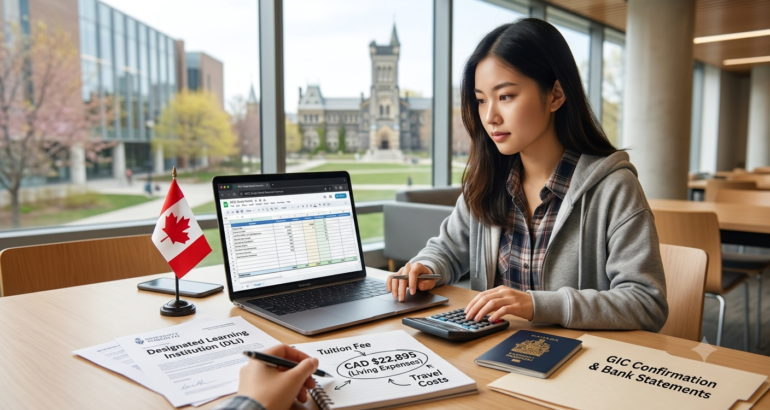
Total Required Funds = First-Year Tuition + CAD $22,895 (Living Expenses) + Travel Costs
+---------------------------------------------------------------------------------+
|                       CANADA STUDY PERMIT FUND BREAKDOWN                        |
+---------------------------------------------------------------------------------+
  [First-Year Tuition Fee]   ──► (Varies by DLI program; e.g., CAD $15,000 - $35,000)
             +
  [Living Expenses Threshold]──► (CAD $22,895 for single applicant outside Quebec)
             +
  [Travel & Contingency]     ──► (Estimated CAD $2,000 - $3,000 for return travel)
             =
  [MINIMUM TOTAL BANK BALANCE TO DEMONSTRATE]
2026 Baseline Living Expense Requirements Outside Quebec
The table below outlines the minimum living expense thresholds required by IRCC based on family size (excluding tuition and travel costs):
| Number of Family Members | Annual Living Expense Requirement (CAD) | Monthly Breakdown (Approx. CAD) |
| 1 (Single Student) | CAD $22,895 | ~$1,908 |
| 2 (Student + Spouse or 1 Dependent) | CAD $28,500 | ~$2,375 |
| 3 (Student + 2 Dependents) | CAD $35,050 | ~$2,920 |
| 4 (Student + 3 Dependents) | CAD $42,500 | ~$3,541 |
| Each Additional Dependent | + CAD $7,500 | + ~$625 |
Note on Quebec: The Province of Quebec sets its own financial threshold through the Ministère de l’Immigration, de la Francisation et de l’Intégration (MIFI). If you are studying in Quebec, you must obtain a Certificat d’acceptation du Québec (CAQ) and meet Quebec’s separate living cost requirements.
What Counts as Acceptable Proof of Funds?
Having sufficient funds in an account is only half the requirement; you must also satisfy the visa officer that these funds are genuinely available, unencumbered, and legally traceable.
IRCC accepts a combination of the following financial documents:
1. Bank Statements (Past 4 to 6 Months)
If you or your sponsors are using liquid cash in a bank account, you must provide official bank statements covering at least the past 4 to 6 months.
- Consistency is Key: Visa officers look for steady balances or logical accumulation through salary deposits or business income.
- Avoid Sudden Large Deposits: Unexplained bulk transfers made right before submitting your application are flagged as “dumped funds” or borrowed money, frequently leading to visa refusals under Regulation 220 of the IRPA.
2. Guaranteed Investment Certificate (GIC)
A Guaranteed Investment Certificate (GIC) is a special fixed-term deposit with an IRCC-approved Canadian financial institution (such as Scotiabank, CIBC, SBI Canada, or ICICI Bank Canada).
Purchasing a GIC equal to the living expense threshold (CAD $22,895) serves as strong proof of financial capability. Once you land in Canada, the bank unlocks an initial sum and releases the remaining balance in monthly installments across your first year.
3. Approved Education Loan Sanction Letter
If you are funding your studies via an education loan:
- The loan must be formally sanctioned by a recognized public or private financial institution.
- The sanction letter must clearly state that the funds are unconditional or conditioned solely upon visa issuance.
- The loan amount should be disbursed directly to your account or to the educational institution.
4. Official Sponsorship Letters and Income Proof
If your parents, legal guardians, or an organization are funding your education, you must establish both their ability and willingness to sponsor you:
- Affidavit of Support: A notarized declaration from your sponsor detailing their relationship to you and their commitment to cover your tuition and living costs.
- Proof of Income: Tax returns (ITRs for the last 2–3 years), salary slips, audited business accounts, or property ownership records proving their ongoing financial capacity.
5. Proof of Paid Tuition and Housing Deposits
Providing an official receipt from your Designated Learning Institution (DLI) showing that you have paid your first-year tuition or proof of a housing deposit for campus residence directly reduces the remaining liquid balance you need to show in your bank statements.
Detailed Step-by-Step Financial Strategy
To build a solid financial portfolio for your study permit application, follow this structured process:
Step 1: Calculate Total First-Year Obligations (Tuition + CAD $22,895 + Flight)
                               │
                               ▼
Step 2: Secure Acceptance & Pay Tuition Deposit to DLI
                               │
                               ▼
Step 3: Purchase Guaranteed Investment Certificate (GIC) or Secure Loan
                               │
                               ▼
Step 4: Compile 6 Months of Clear, Traceable Bank Statements & Income Documents
                               │
                               ▼
Step 5: Write a Comprehensive Statement of Purpose (SOP) Financial Breakdown
Step 1: Calculate Your Target Fund Threshold
Before compiling paperwork, add your exact first-year tuition fee (as listed on your DLI Letter of Acceptance) to the CAD $22,895 living expense requirement. Add an estimated CAD $2,000 to $3,000 for travel and medical coverage.
Example Target: If your tuition is CAD $20,000:
Target Funds = $20,000 (Tuition) + $22,895 (Living) + $3,000 (Travel) = CAD $45,895
We recommend holding a buffer of 10% to 15% above the minimum limit to account for currency exchange fluctuations and unforeseen personal expenses.
Step 2: Organize Your Sponsor Profile
If relying on parental or third-party sponsorship:
- Limit your sponsors to close family members (parents, legal guardians, or grandparents). Third-party sponsorship from distant relatives or friends carries a high risk of refusal due to lack of demonstrated obligation.
- Provide clear proof of relationship, such as birth certificates or family registries.
Step 3: Draft a Transparent SOP Financial Section
In your Statement of Purpose (SOP) or Letter of Explanation, include a summary table explaining your financial structure. Clearly break down:
- Total anticipated costs for year one.
- Exact sources of funds (GIC, savings accounts, education loan, sponsorship).
- The origin of any recent large transactions to eliminate officer skepticism.
Top Reasons Study Permits Are Refused on Financial Grounds
Understanding why visa officers reject financial files helps you avoid simple mistakes. The most common grounds for refusal under section R220 include:
- Unexplained Recent Deposits: Depositing a large sum into a bank account weeks before filing without providing source documents (such as property sale deeds, investment redemptions, or asset liquidation proofs) leads officers to conclude the money is borrowed temporarily.
- Insufficient Source of Income: Even if an account holds CAD $50,000, the application may be refused if the sponsor’s annual declared income is too low to explain how that money was accumulated.
- Encumbered or Illiquid Assets: Property valuations, gold, or fixed assets cannot be used as primary proof of living expenses because they are not liquid. They can only be presented as secondary evidence of overall financial strength.
- Ignoring Subsequent Study Years: While you must demonstrate liquid cash for Year 1, you must also show a realistic plan or source of income for subsequent years of multi-year degree or diploma programs.
Summary Checklist for 2026 Canadian Study Permit Financials
Before submitting your application on the official IRCC Portal, double-check that your financial package includes:
- [ ] First-year tuition receipt or proof of sufficient liquid funds to cover the full tuition amount.
- [ ] Proof of CAD $22,895 (for a single student) in liquid funds for living costs outside Quebec.
- [ ] Official GIC confirmation letter from an approved Canadian bank (if applicable).
- [ ] Past 4 to 6 months of consecutive, official bank statements with certified bank stamps.
- [ ] Notarized Affidavit of Financial Support from sponsors, supported by 2–3 years of tax returns and employment records.
- [ ] Unconditional education loan sanction letter (if utilizing a bank loan).
- [ ] Detailed SOP financial table explaining all monetary sources and proving unencumbered ownership.
Navigating the financial requirements for a Canadian study permit requires thorough documentation and absolute transparency. By preparing your financial documents early, establishing a clear line of funding, and keeping your balances stable, you set a strong foundation for a successful study permit application.
For personalized assistance with your study permit application, Provincial Attestation Letters (PAL), or document verification, you can review expert guidance through Real World Immigration’s Study Permit Assessment Services. For official guidelines, updates, and policy notifications, refer directly to the Government of Canada Study Permit Portal.

Swati Raj

Leave a Comment