Sponsor Dependent Child to Canada 2026: Age Rules & Guide
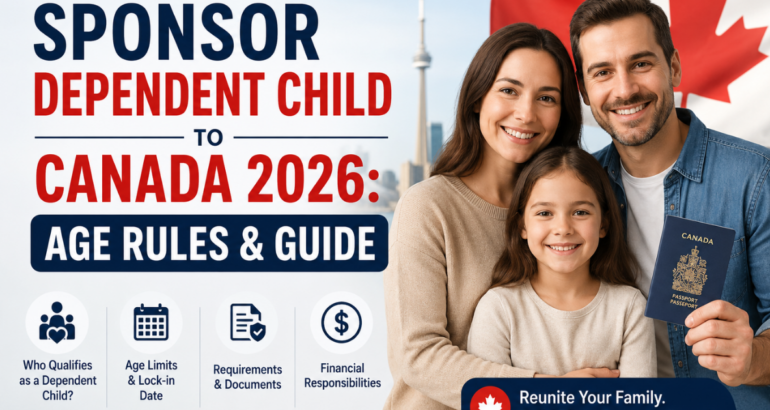
There is nothing quite as important as ensuring your children are by your side, safely growing up within a country that offers world-class education, security, and a bright future. If you are a Canadian citizen or Permanent Resident (PR), bringing your son or daughter to Canada under the Family Class Sponsorship program is one of the most direct avenues available.
However, navigating the legal framework established by Immigration, Refugees and Citizenship Canada (IRCC) involves strict statutory definitions. A common misunderstanding surrounds the exact definition of a “dependent child,” how age limits are calculated, and what legal exceptions apply to older children or complex custody situations.
At Real World Immigration, our experienced consulting team in Brampton, Ontario, regularly assists families across Canada and around the globe in reuniting with their children. This definitive 2026 guide covers core age rules, the crucial “lock-in date” concept, custody requirements, and step-by-step strategies to ensure a smooth, successful application.
1. What Is the Age Limit for Sponsoring a Child to Canada?
Under Canadian immigration law, IRCC applies a standardized two-part test to evaluate whether a child qualifies as a dependent.
To sponsor your biological or legally adopted child under standard stream guidelines, the child must satisfy both of the following conditions on the date the application is officially logged:
- Age Requirement: The child must be under 22 years of age (i.e., 21 years old or younger).
- Marital Status Requirement: The child must not have a spouse or common-law partner. They must remain single throughout the entire processing window.
If your child meets these criteria, you can sponsor them without having to meet minimum income requirements in most general scenarios.
2. The Over-22 Exception: Sponsoring Adult Children
What happens if your child is 22 years of age or older? Can they still be sponsored as a dependent?
Generally, once a child turns 22, they are expected to apply for Canadian permanent residence through independent economic streams (such as Express Entry or Provincial Nominee Programs). However, IRCC makes a vital statutory exception for adult children who are unable to live independently.
An adult child aged 22 or older qualifies as a dependent only if they meet both of the following conditions:
- Continuous Financial Dependence: They have relied continuously on their parents for financial support since before reaching the age of 22.
- Physical or Mental Health Condition: They are unable to financially support themselves due to a documented physical or mental condition.
Critical Note: Full-time enrollment in university or higher education is no longer a valid reason on its own to sponsor a child over 22. In previous years, full-time students were exempt; under current IRCC regulations, post-secondary education does not exempt an able-bodied adult child over 22 from the age limit.
3. The “Lock-In Date”: Protecting Your Child from Aging Out
Immigration processing can take several months—or even years—depending on country-specific processing queues. A major concern for parents is: What happens if my child is 21 when I apply, but turns 22 while IRCC is still reviewing the file?
This is where the concept of the Lock-In Date protects your family.
How the Lock-In Date Works
The Lock-In Date is the official date IRCC receives your complete permanent residence application package. On that exact day, your child’s age is legally frozen for the entire duration of the application processing period.
- Example: If your child turns 22 on November 15, and IRCC receives your complete sponsorship package on November 10 (when they are still 21), your child’s age is locked in at 21. Even if the application takes 14 months to process and the child is 23 when the PR visa is issued, they remain eligible.
Crucial Requirement: Marital Status Cannot Lock In
While age locks in, marital status does not. Your child must remain single and not enter into a common-law union from the day you file the application right up until the moment they land in Canada as a Permanent Resident. If they marry during processing, their PR status will be canceled, even if their age was locked in before 22.
4. Sponsor Eligibility vs. Financial Undertaking Rules
To sponsor a dependent child, the parent residing in Canada must fulfill clear legal qualifications set out under the Immigration and Refugee Protection Act (IRPA).
Who Can Sponsor?
To qualify as a sponsor, you must:
- Be at least 18 years old.
- Be a Canadian Citizen, a Permanent Resident living in Canada, or a person registered under the Canadian Indian Act.
- Reside in Canada (Canadian citizens living abroad may sponsor if they demonstrate concrete intent to return to Canada once the child receives PR; Permanent Residents must reside inside Canada throughout the entire process).
- Not be receiving social assistance for reasons other than a disability.
- Not be bankrupt, in prison, or under an active deportation/removal order.
Income Requirements (LICO Exception)
Unlike parent/grandparent sponsorship, there is no Minimum Necessary Income (MNI / LICO) requirement to sponsor a dependent child in most situations. You do not need to show a specific tax threshold on your CRA Notice of Assessment.
The Exception: If the dependent child you are sponsoring has dependent children of their own (i.e., your grandchildren are included in the application), the sponsor must meet the strict LICO income benchmark for their total household size.
Length of Financial Undertaking
When you sponsor a child, you sign a binding financial contract with the Canadian government known as an Undertaking. This contract obligates you to provide housing, food, clothing, and basic daily living expenses for the child.
| Age of Sponsored Dependent Child | Length of Undertaking Commitment |
| Child under 22 years old (when PR is granted) | 10 years, or until the child turns 25 (whichever comes first). |
| Child 22 years of age or older (over-age exception) | 3 years from the date they become a Permanent Resident. |
Note for Quebec Residents: The Province of Quebec manages its own undertaking durations under provincial immigration regulations. Consult with our team if you reside in Quebec to review local schedules.
5. Custody Laws and Non-Accompanying Parent Consent
Sponsoring a child from a previous marriage or relationship introduces specific legal safeguards designed to prevent international parental child abduction. IRCC takes custody laws very seriously.
The IMM 5604 Declaration Form
If you are sponsoring a minor child (under 18 years old) and the child’s other biological parent is not immigrating to Canada, the non-accompanying parent must sign Form IMM 5604 (Declaration from Non-Accompanying Parent/Guardian). This document must be notarized and submitted alongside a copy of that parent’s official photo ID.
What If the Other Parent Refuses to Sign?
If the non-accompanying parent refuses to grant consent or cannot be located, you cannot simply bypass this requirement. You must submit official legal court documents demonstrating that:
- You hold sole legal custody and sole decision-making authority regarding the child’s residence, OR
- A family court has issued a specific order authorizing you to permanently remove the child from the country of origin to reside in Canada.
Failing to address parental consent correctly is one of the top reasons minor child sponsorship files stall or face refusal.
6. Sponsoring Adopted Children: Key Considerations
Canadian citizens and permanent residents can also sponsor adopted children, but the legal structure depends heavily on where the adoption took place.
- Intercountry Adoptions: Adoptions completed outside Canada must comply with both Canadian federal/provincial laws and the laws of the child’s home country. If the home country is a signatory to the Hague Adoption Convention, specific international safeguards must be fulfilled before the adoption is recognized for immigration purposes.
- Genuine Parent-Child Relationship: IRCC verifies that the adoption was completed in the best interests of the child and was not executed solely to grant the child entry into Canada.
- Citizenship Direct Route vs. Sponsorship: In certain scenarios where a Canadian citizen parent adopts a child abroad, the child may be eligible to apply directly for Canadian Citizenship under Section 5.1, bypassing the Permanent Residency sponsorship queue altogether.
7. Step-by-Step Sponsorship Application Blueprint
To ensure your child’s file moves through IRCC channels without delays, follow this structured roadmap:
Step 1: Verify Age & Eligibility
Confirm the child is under 22 (or qualifies under the over-22 disability rule) and unmarried.
  │
  ▼
Step 2: Assemble Vital Identity & Relationship Documents
Gather official long-form birth certificates, adoption deeds, passports, and joint custody documents.
  │
  ▼
Step 3: Obtain Non-Accompanying Parent Clearance (If Applicable)
Execute Form IMM 5604 with a notary or confirm full sole custody court orders.
  │
  ▼
Step 4: Complete IRCC Digital Application Package
Fill out Sponsorship Application (IMM 1344), Generic Application for Canada (IMM 0008), and child schedule forms via the PR Portal.
  │
  ▼
Step 5: Pay Federal Processing & Biometric Fees
Pay standard fees online ($75 sponsorship fee + $150 child PR fee + $85 biometrics).
  │
  ▼
Step 6: Submit Package & Secure Your Lock-In Date
File electronically to establish the official Lock-In Date, freezing your child's age for evaluation.
  │
  ▼
Step 7: Complete Medical Exams & Biometrics
When prompted by IRCC, take your child to an authorized Panel Physician for medical clearance and book biometrics at a VAC.
8. Common Pitfalls That Cause Application Delays or Rejections
Sponsoring a child seems straightforward, but administrative oversights can derail your file:
- Submitting Short-Form Birth Certificates: IRCC requires a long-form birth certificate that clearly lists the names of both biological parents. Short-form cards that only show the child’s name will be rejected.
- Missing the Undeclared Child Public Policy Deadline: If you became a Permanent Resident in the past and failed to declare your child on your original PR application (violating Section 117(9)(d) of IRPR), you normally lose the right to sponsor them. However, a temporary public policy allows sponsors to overcome this under specific conditions—speak with legal counsel immediately if this applies to you.
- Incomplete Translations: Any document (birth certificates, custody orders, adoption papers) not in English or French must be accompanied by an official certified translation and a translator’s affidavit.
- Ignoring Changes in Marital Status: Failing to notify IRCC if an older child enters a relationship during processing will lead to misrepresentation charges or cancellation of status.
9. How Real World Immigration Helps Protect Your Family’s Future
When it comes to bringing your children to Canada, you cannot afford paperwork mistakes or processing delays that risk pushing a child past critical age boundaries.
Operating out of Brampton, Ontario, our certified team at Real World Immigration specializes in managing complex family class applications:
- Lock-In Date Precision: We expedite document preparation to lock in your child’s age as quickly as possible, eliminating the risk of them aging out.
- Custody & Consent Resolution: We assist in structuring legally compliant consent documentation and court orders for non-accompanying parent scenarios.
- Over-22 & Medical Case Filings: We help compile detailed medical, psychological, and financial records required to sponsor adult children with disabilities.
- Audit-Ready Submissions: We ensure every birth certificate, translation, and IRCC form is thoroughly verified before final submission.
Explore our complete array of solutions on our Real World Immigration Services Page or learn more about our experienced team on our About Us Page.
Bring Your Child Home to Canada
Navigating child sponsorship rules does not have to be overwhelming. By understanding key age cutoffs, locking in your application date early, and ensuring your documentation is complete, you can secure your child’s permanent residency smoothly.
Don’t let aging-out deadlines pass you by.
Contact our certified immigration experts at Real World Immigration today to book a comprehensive consultation. Let us handle the legalities while you focus on preparing for your child’s arrival in Canada.

Swati Raj
Leave a Comment